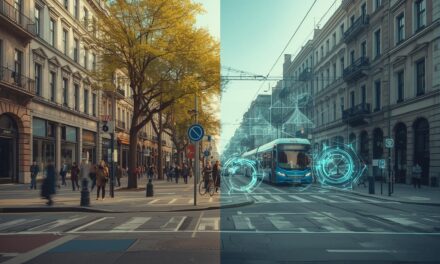

At 3:47 AM on a Tuesday in Singapore, a pressure sensor buried beneath Orchard Road detected a 2% drop in water flow.
Within minutes, the city’s predictive maintenance system had calculated the probable failure point, dispatched a repair crew, and rerouted water supply to prevent service disruption. By the time most residents woke up, the leak was fixed. No flooded streets. No emergency repairs. No wasted water.
This is not a vision of the future. This is how cities operate in 2025 and beyond.
The smart city has moved beyond pilot projects and proof-of-concept demonstrations. Cities now run on integrated systems that convert physical events into digital signals, process them through AI-driven platforms, and execute responses before problems escalate. The question is no longer whether cities should adopt smart infrastructure, but how to build systems that actually work at scale.
The difference between a city with sensors and a genuinely smart city comes down to integration. Most municipalities have installed IoT devices. Far fewer have built the four-layer architecture needed to turn sensor data into operational decisions. Even fewer have solved the governance problem: breaking down departmental silos so water, transport, and energy systems can share data and coordinate responses.
This article maps the technical and operational journey that urban data takes from a physical sensor to a strategic decision at City Hall. Understanding this path matters because the cities that master it will spend 40-60% less on infrastructure maintenance, reduce emergency failures by up to 85%, and deliver measurably better services to residents.
The cities that don’t will keep funding reactive repairs while their infrastructure ages faster than they can fix it.
The Four-Layer Architecture: How Cities Process Reality
Most cities have Layer 1. They have sensors. The competitive advantage is in Layers 2-4: network transmission, intelligent processing, and automated execution.
Think of it this way: data without transmission is just noise. Transmission without processing is just storage costs. Processing without execution is just dashboards no one acts on.
The 2026 smart city operates on a standardized four-layer architecture:
Layer 1 – Sensing Layer: Physical devices that capture urban activity (IoT sensors, cameras, smart meters, actuators)
Layer 2 – Network Layer: Communication infrastructure that transports data (5G/6G, LoRaWAN, NB-IoT, fiber-optics)
Layer 3 – Data Layer: Processing platforms that analyze and contextualize information (FIWARE, cloud/edge computing, digital twins)
Layer 4 – Application Layer: Systems that execute responses (dashboards, AI agents, citizen apps, Urban Operation Centers)
The failure point for most cities sits between Layer 3 and Layer 4. They can collect and analyze data, but they cannot convert analysis into automatic responses. A traffic management system that displays congestion patterns on a screen is not a smart city. A traffic management system that automatically adjusts signal timing and suggests alternate routes without human intervention is.
Cities that master all four layers do not just monitor infrastructure. They manage it as a dynamic system that responds to conditions in real time.
From Sensor to Signal: The Data Collection Problem
Cities generate 2.5 petabytes of data daily. They analyze less than 10% of it.
The challenge is not deploying sensors. The challenge is deploying sensors that can operate reliably for years without constant maintenance. This matters because a city might install 10,000 environmental sensors across its territory. If those sensors require battery replacement every 18 months, the maintenance cost exceeds the original hardware investment.
One mid-sized European city deployed 5,000 air quality sensors in 2023 without a power management strategy. Within two years, it spent three times the projected budget on battery replacement and technician visits. The data was valuable. The operational model was not.
This explains why energy harvesting has become a strategic priority in 2026. Energy Harvesting Systems (EHS) convert ambient light, thermal gradients, vibration, or RF energy into usable power. Self-powered sensors eliminate battery replacement cycles and reduce long-term operational costs by 60-70%.
The physical sensing layer now includes:
Environmental monitors: Air quality, noise levels, temperature, humidity, soil moisture in public parks
Infrastructure sensors: Water pressure and leak detection, structural stress monitors on bridges, pavement condition sensors
Utility tracking: Smart meters for electricity, gas, and water consumption at building and district levels
Actuators: The response mechanisms that allow cities to take physical action remotely, opening flood gates, reconfiguring traffic light patterns, or adjusting street lighting based on pedestrian density
Sensor diversity matters less than sensor integration. A city with 50,000 disconnected sensors has less operational intelligence than a city with 5,000 sensors feeding into a unified processing platform.
The Network Layer: Why Connectivity Choices Matter
The network layer determines what kind of smart city you can build. The decision between 5G and Low-Power Wide-Area Networks (LPWAN) is not a technical preference. It is a strategic choice with budget and capability implications.
5G infrastructure costs 5-10 times more than LPWAN but handles 100 times more data. High-bandwidth 5G or experimental 6G networks support data-heavy applications like real-time video analytics, autonomous vehicle coordination, and augmented reality interfaces for field technicians. LPWAN technologies like LoRaWAN or NB-IoT work for low-data-rate sensors that report infrequently: soil moisture readings, parking space occupancy, or waste bin fill levels.
The question is not which technology is better. The question is which response time requirements and data volumes your city needs to support.
Most cities in 2025 operate hybrid networks. They deploy 5G in high-traffic commercial districts where real-time video monitoring and dense IoT device clusters require high bandwidth. They use LPWAN in residential areas and parks where sensors report status updates a few times per hour.
Cellular IoT connections in cities are growing at 17.9% annually. 5G coverage is projected to reach 65% of the global population by late 2025. This expansion matters because network coverage gaps create operational blind spots. A predictive maintenance system for water infrastructure fails if 30% of the pipe network lacks connectivity.
Cities must choose between two infrastructure philosophies: “sense everything” or “sense what matters.” The first approach is comprehensive but expensive. The second is targeted but requires upfront analysis to identify which systems deliver the highest value from real-time monitoring.
Cities that choose poorly either overpay for bandwidth they do not need or underbuild capacity and cannot support future applications.
The Urban Brain: FIWARE and the Integration Battle
The biggest barrier to smart cities is not technology. It is vendor lock-in and proprietary systems that refuse to communicate with each other.
A city might have a traffic management system from Vendor A, a water monitoring platform from Vendor B, and an energy grid from Vendor C. When an infrastructure event requires coordination across all three systems, integration becomes the bottleneck. One North American city spent $8 million over three years trying to connect incompatible vendor platforms. The project ultimately failed because the vendors had no incentive to enable interoperability.
This is why open standards matter more than advanced features.
FIWARE has emerged as the de facto integration framework for smart cities in 2025. It is an open-source platform that provides standardized APIs and information models. The core component is the Orion Context Broker, which aggregates context information from multiple sources and makes it available to applications in real time.
FIWARE breaks down vertical silos. Instead of separate, isolated systems for water, transport, and energy, cities build a unified data layer that allows any authorized application to access any relevant data stream. A flood response system can pull data from weather sensors, traffic cameras, and water treatment facilities simultaneously because they all report to the same context management layer.
The alternative to open standards is continued fragmentation. Cities that lock themselves into proprietary vendor ecosystems pay premium prices for integration work, cannot easily switch providers, and limit their ability to adopt new technologies as they emerge.
The strategic choice is clear: prioritize interoperability over feature completeness. A less sophisticated system that connects easily to future components is more valuable than a cutting-edge platform that operates in isolation.
Digital Twins: Testing Before Building
Digital twins are dynamic virtual models of physical infrastructure. They allow cities to simulate scenarios before committing resources to real-world implementation.
Testing flood response strategies in a digital twin costs approximately $50,000. Testing the same strategies through pilot programs in physical infrastructure costs $5 million and risks actual damage if the approach fails.
Cities use digital twins to model traffic flow changes when a new office building opens, simulate the impact of tree planting on local temperature, or test emergency evacuation routes before a major public event. The value is not in the simulation itself but in the ability to identify problems before they become expensive failures.
Urban Digital Twins (UDTs) represent infrastructure as living systems that change over time. A static map shows where pipes are located. A digital twin shows which pipes are degrading, which sections experience the highest stress, and where failures are most likely to occur in the next six months.
The cities that build digital twins gain the ability to make infrastructure decisions based on predictive models rather than reactive responses.
Application Layer: Where Analysis Becomes Action
70% of smart city projects fail not because of bad data, but because departments cannot or will not act on insights.
The application layer is where integration either succeeds or collapses. This layer includes Urban Operation Centers (UOCs), AI-driven automation systems, and citizen-facing applications.
Urban Operation Centers: Coordination, Not Just Dashboards
A UOC is not a room full of screens displaying real-time data. It is a coordination mechanism that connects departments and enables cross-functional responses.
Cities like Rio de Janeiro, London, and Singapore run UOCs that unify data from surveillance systems, emergency response, public utilities, and transport networks. When an incident occurs, the UOC does not just display information. It routes alerts to the appropriate departments, activates pre-defined response protocols, and tracks resolution in real time.
The difference between a dashboard and an operation center is decision authority. A dashboard shows problems. An operation center has the organizational structure and workflow automation to solve them.
Agentic AI: Autonomous Execution
The most significant shift in 2025 is the introduction of agentic AI, autonomous agents that execute multi-step workflows with minimal human supervision.
Traditional AI systems flag issues and recommend actions. Agentic AI systems execute actions directly.
Cities now deploy AI agents that automatically process building permit applications, flag code violations, calculate regulatory fees, and route approvals to the appropriate departments. The AI does not just identify a zoning violation. It generates the compliance notice, schedules the inspection, and updates the case management system.
Traffic optimization systems like ET City Brain in Hangzhou or Surtrac in Pittsburgh adjust signal timing in real time based on traffic patterns. These systems reduced travel times by 25% and CO2 emissions by 20% without human intervention. The AI monitors traffic flow, identifies congestion patterns, and recalibrates signal sequences automatically.
The value of agentic AI is not that it works faster than humans. The value is that it works continuously without fatigue, applies decision rules consistently, and scales across thousands of simultaneous processes.
Breaking Departmental Silos
The governance challenge is harder than the technical challenge. Water departments, transport agencies, and energy utilities have operated independently for decades. They have separate budgets, separate IT systems, and separate performance metrics.
Making smart cities work requires cross-departmental data sharing and coordinated responses. This means restructuring how municipal government operates.
Cities that succeed in 2025 have created new organizational roles: Chief Data Officers who manage city-wide data strategy, inter-departmental task forces with shared performance targets, and unified data governance frameworks that define who can access what information under which conditions.
The technology enables integration. Governance determines whether integration actually happens.
The Economics: Why Predictive Maintenance Changes Everything
Traditional municipal maintenance is reactive. Infrastructure breaks, and the city fixes it. This approach consumes 25-35% of maintenance budgets on emergency repairs, which cost 3-4 times more than planned maintenance.
Predictive maintenance flips the model. Instead of waiting for failures, cities use sensor data and AI analysis to identify problems before they occur. A water pipe showing abnormal pressure patterns gets repaired during scheduled maintenance, not at 3 AM when it ruptures and floods a neighborhood.
The financial impact is substantial:
| Infrastructure Type | Primary IoT Solution | Cost Reduction |
|---|---|---|
| Water Systems | Pressure & flow sensors | 50-65% |
| Transport Networks | Traffic & structural sensors | 40-55% |
| Energy Grids | Smart meters & fault sensors | 35-50% |
| Public Buildings | HVAC & occupancy monitors | 45-60% |
Cities using predictive maintenance report 70-85% reductions in emergency infrastructure failures. They spend less overall and deliver more reliable services.
The challenge is the investment timeline. Predictive maintenance requires upfront spending on sensors, connectivity, and analytics platforms before any savings materialize. Most cities see positive ROI in 18-24 months, but it takes 6-12 months to establish the data baseline needed for accurate predictions.
This creates a budget cycle problem. City councils resist funding infrastructure that will not show benefits until after the next election. The cities that overcome this political hurdle gain a long-term operational advantage. The cities that do not continue paying premium prices for reactive repairs.
Vendor Landscape: Who Controls the Operating System
Should cities build custom platforms or adopt vendor solutions? The trade-offs are control versus speed, customization versus support.
The smart city market in 2025 is dominated by a few major players who provide integrated “urban operating systems”:
Cisco focuses on network infrastructure and security architecture for scalable deployments. Cities that prioritize cybersecurity and network reliability choose Cisco.
Siemens specializes in integrated solutions for smart energy, building automation, and transport systems. Cities with significant existing Siemens infrastructure find it easier to extend their deployment than to switch vendors.
Microsoft Azure leads in cloud platforms, AI-powered workflows, and open data frameworks. Cities that want flexibility to integrate third-party applications favor Azure’s platform approach.
IBM provides big data analytics and predictive maintenance tools designed for large-scale infrastructure. Cities with complex legacy systems often choose IBM for its integration capabilities.
Hitachi integrates IT, operational technology, and IoT for smart mobility and energy optimization. Cities focused on transport and energy efficiency select Hitachi.
The strategic question is not which vendor offers the best technology. The question is which ecosystem provides the best long-term fit for your city’s existing infrastructure, technical capabilities, and strategic priorities.
Integrated suites from single vendors offer simplicity and guaranteed compatibility. Best-of-breed component approaches offer flexibility and the ability to switch providers, but require more internal technical expertise to maintain.
The vendor you choose in 2025 will determine your infrastructure flexibility for the next decade. Cities that select proprietary platforms lock themselves into long-term dependencies. Cities that choose open-standard platforms maintain optionality but accept more integration complexity.
The Four Barriers to Scale
Technology is not the constraint. Governance, procurement, workforce readiness, and security are.
Barrier 1: Interoperability and Procurement
Cities accidentally create vendor lock-in through poorly written procurement requirements. An RFP that specifies detailed technical features rather than open standards forces vendors to propose proprietary solutions. Once a city deploys one vendor’s platform, switching costs become prohibitively expensive.
The solution is to write procurement requirements around interoperability standards like FIWARE or NGSI APIs, not around feature checklists. This allows multiple vendors to compete and prevents long-term dependency on a single provider.
Barrier 2: Data Governance and Algorithmic Bias
Who owns the data generated by smart city sensors? The city, the vendor, or the citizens? The answer determines what happens to that data.
Predictive policing algorithms have been documented targeting minority neighborhoods at higher rates than wealthy areas, not because of actual crime patterns but because of biased training data. Cities that deploy AI-driven decision systems without bias audits risk codifying discrimination into infrastructure.
Data governance frameworks must define data ownership, establish anonymization requirements, mandate algorithmic transparency, and create accountability mechanisms for automated decisions.
Barrier 3: Operational Readiness
Most city IT departments are structured to maintain desktop computers and email servers, not to manage IoT sensor networks, edge computing platforms, and AI agents.
Smart city infrastructure requires new technical skills: data engineering, machine learning operations, cybersecurity for industrial control systems, and real-time systems management. Cities must either hire specialists or retrain existing staff. Both options take time and budget.
Cities that deploy smart infrastructure without building operational capacity end up with systems they cannot maintain. The technology works for 18 months until the vendor support contract expires, then gradually degrades because internal staff lack the expertise to troubleshoot problems.
Barrier 4: Cybersecurity and Systemic Risk
As cities become hyper-connected, they become vulnerable to catastrophic attacks. One ransomware infection can shut down traffic lights, water treatment plants, emergency dispatch systems, and public transit simultaneously.
A successful cyberattack on a smart city is not an inconvenience. It is a public safety crisis.
Cities must implement defense-in-depth security architectures that follow NIST Cybersecurity Framework and ISO 27001 standards. This means network segmentation to isolate critical systems, continuous monitoring for anomalous behavior, regular penetration testing, and incident response plans that assume breaches will occur.
The cities that treat cybersecurity as a compliance checkbox will eventually suffer a major incident. The cities that treat it as a continuous operational discipline will mitigate most threats before they cause damage.
The Integration Imperative
Smart cities in 2026 are defined not by how many sensors they deploy, but by how effectively they close the loop between sensing an event and executing a response.
The journey from sensor to City Hall decision requires integration across four technical layers and coordination across multiple government departments. Most cities have invested in Layer 1. Few have mastered Layers 2-4. Even fewer have solved the governance problem.
Cities considering smart infrastructure investments should follow this framework:
Start with one high-value use case. Do not try to build an entire smart city at once. Pick one domain where predictive maintenance delivers clear ROI: water systems, traffic management, or energy grids. Build competency in that domain before expanding.
Prioritize interoperability over feature completeness. Choose platforms that support open standards even if they have fewer features than proprietary alternatives. The ability to integrate future components matters more than today’s feature checklist.
Build governance structures before scaling technology. Create cross-departmental coordination mechanisms, establish data sharing agreements, and clarify decision authority before deploying city-wide sensor networks. Technology without governance creates expensive data silos.
Measure time-to-action, not data collected. The metric that matters is how quickly your city converts a sensor alert into an executed response. Data volume is irrelevant if it does not drive faster, better decisions.
The cities that master this integration will deliver measurably better services at lower cost. The cities that do not will keep funding an increasingly expensive reactive maintenance cycle until their infrastructure fails faster than they can repair it.
The difference between a city with sensors and a smart city is not the technology. It is the ability to turn information into action.