
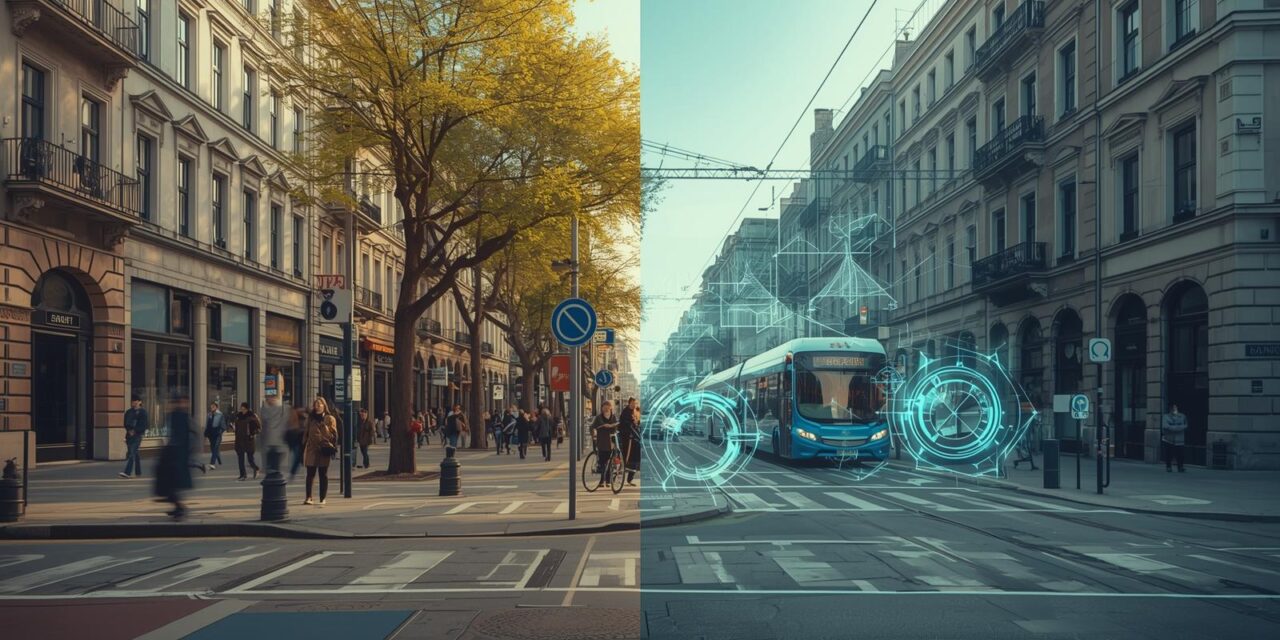
Zurich ranks first in the 2025 IMD Smart City Index. Singapore is ninth. Both cities deploy digital twins, Edge AI, and 6G-enabled sensor networks.
Yet in Zurich, when residents describe what makes their city “smart,” they talk about affordable housing and 15-minute neighborhoods. In Singapore, they mention autonomous buses and real-time flood prediction.
The difference reveals what changed in 2025. Smart cities stopped being about the technology itself. The sensors, the algorithms, the fiber optic cables became infrastructure, invisible and assumed. What matters now is what those tools actually deliver: housing you can afford, air you can breathe, transit that gets you home in time for dinner.
This shift from tech-centric to human-centric defines the 2026 smart city.
After two decades of pilot projects and vendor promises, cities finally have frameworks that work:
- The ITU established global KPIs.
- UN-Habitat published people-centered guidelines.
- ISO created measurable standards.
More importantly, cities have a decade of failures to learn from: surveillance backlash, algorithmic bias, green gentrification that displaced the communities it claimed to help.
The 2026 smart city is what survived that reckoning. This analysis examines how international standards bodies redefined “smart,” why the computing continuum finally enables human-centric outcomes, and which cities are implementing these frameworks successfully.
Three insights emerge: housing affordability now determines smart city rankings more than bandwidth, mobility integration matters more than individual transport technologies, and data governance separates leaders from laggards.
📘 Smart Cities 2026 – Introductory Series
Part 1: Why Technology Finally Became Invisible ← You are reading it
Part 2: What Separates Leaders from Laggards
Part 3: Your Action Plan
The 2026 Definition: What Changed
The International Telecommunication Union and UN-Habitat converged on a “people-centered” framework in 2024-2025 that marks a clean break from earlier definitions.
The ITU’s “United for Smart Sustainable Cities” initiative now defines smart cities as urban areas that use ICTs to improve quality of life while meeting the needs of present and future generations across economic, social, and environmental dimensions.
Three pillars anchor this definition:
First, quality of life improvement measured through citizen experience rather than administrative efficiency.
Second, environmental resilience built into infrastructure from the start, not retrofitted later.
Third, inclusive governance that gives residents direct input into budget allocation and project priorities.
The measurement shifted from “tech density” to “outcome delivery.” Cities no longer earn points for sensor count or fiber optic coverage. The 2025 IMD Smart City Index reveals the new priority: housing affordability ranks as the top citizen concern in 110 of 146 cities surveyed. The index specifically measures whether rent equals 30% or less of average monthly salary. Cities that fail this test cannot score above 75, regardless of their technological sophistication.
This explains Zurich’s first-place ranking. The city deployed sophisticated digital twins and mobility platforms, but residents credit the participatory budgeting system that let them vote on local projects. They credit the decision to reclaim road space from cars to create pedestrian infrastructure. They credit policies that kept housing accessible even as the city modernized its digital backbone.
Singapore ranks ninth despite superior technology because housing costs remain the primary citizen complaint. The city’s Open Digital Platform in Punggol Digital District represents world-class integration. Yet the IMD framework penalizes cities where digital advancement outpaces social equity.
The 2065 definition makes this trade-off explicit: technology serves people, or it does not count as “smart.”
The Technology That Finally Works
Three technical advances in 2024-2025 solved problems that stalled smart city projects for a decade. The computing continuum, Edge AI, and urban digital twins moved from pilot stage to reliable municipal infrastructure.
The computing continuum integrates Edge, Fog, Cloud, and High-Performance Computing into a unified architecture. This matters because it solved two critical failures: latency and privacy. Earlier smart city projects sent all data to central cloud servers for processing. This created delays measured in seconds, acceptable for analyzing traffic patterns but fatal for autonomous systems that need millisecond response times. It also required transmitting sensitive personal data across networks, triggering justified privacy concerns that killed projects in Barcelona, Toronto, and Portland.
Edge AI pushes intelligence directly into local devices: traffic cameras, building sensors, utility grid controllers. These systems process data locally and discard everything except anonymized insights. A camera detects pedestrian movement and adjusts crossing signals in real time without storing facial images or tracking individuals. Grid sensors balance power loads across microgrids without reporting household consumption patterns to utilities.
Singapore’s Open Digital Platform demonstrates this architecture in practice. The Punggol Digital District runs waste collection, energy distribution, and mobility coordination through integrated Edge systems. The platform is “open” because businesses and researchers can access anonymized data to test new applications. This creates a living lab where private sector innovation gets tested at municipal scale before wider deployment.
South Korea’s LX Digital Twin Institute shows why this matters for climate resilience. The institute received €23 million (2024-2027) to build digital twins focused specifically on climate prediction and damage prevention. These models combine satellite data with street-level sensor feeds to predict flooding 48 hours ahead with block-by-block precision. When heavy rain approaches Seoul, the system automatically reroutes buses, closes vulnerable underpasses, and activates stormwater systems before water accumulates.
Digital twins evolved from visualization to prediction. Early versions created impressive 3D city models useful for presentations but limited for decision-making. The 2025 generation runs continuous simulations. Planners test infrastructure changes in the virtual environment before spending money in the physical world. They model where to place solar panels by simulating sun exposure across seasons. They identify optimal locations for affordable housing by testing impact on transit, schools, and utilities.
The technology finally works because it answers specific questions with measurable outcomes. Seoul reduced flood damage by 40% in pilot districts. Singapore cut waste collection costs by 30% through route optimization. Zurich decreased crosstown travel time by 25% through signal coordination that adjusts to real traffic flow rather than fixed schedules.
Cities stopped buying technology and started buying solutions to problems that residents actually care about.
Understanding the technology that finally works sets the foundation. Part 2 examines what top-ranked cities do with these tools that others don’t—and where even leaders still fail.